shabby blog
changes in latitudes header
49ers
5k fundraiser
adventures
Aidan
Ancel Keys
Aunt Sandy Uncle Dave
B.S.
bad days
bad storm
baking
basketball
be happy
beachin' it
BEAT DOOK
Becky
bestest friends in the world
BIG WIN
blessed
blogging
boot camp
Bryttava and Rob
Campbell
campbell clan
cappuccino
carbohydrates
catnip plant
challenge child
change
cheer
christmas
church
close call
Coach Harbaugh
courage
croissants
Dad
Devin
Dexter Strickland
DINKing it
do something
Doherty
Earth Day
Easter bunny
eat good food
encouragement
EPIC FAIL
evolution
family
family bakery
family origins
fat
February
FIND A CURE
fishing
Florida
flowers
football
French cafe
friends
fun
gamblin'
gardening
getting in shape
ghrelin
glucose
GO PHIL
God
good book
good cause
good food
good movie
good science/bad science
GOOFBALLS
green beer
green thumb
grief
growing up
GW
Haley
happy birfday
Happy Groundhog Day
Happy Saint Patty's Day
Harbaugh Bowl
Harrison Barnes
health
health quest
hibatchi
highs and lows
history lesson
holidays
House of Refuge
hug a tree. endangered animals
Hutchinson Island
in Roy We Trust
insulin
Ireland
Irish Royalty
Jimmy Buffett
Johnny
Jonathan
Judy
Judy and Tom
Kathy
kayaking
Kendall Marshall
Kentucky
ketones
ketosis
Kevin
kid-at-heart
laugh
Leo the cat
leptin
Lois
Lois and Steve
love
love my job
love this weather
LOVE VISITORS
lucky me
lucky to be alive
macaroons
man vs nature
margaritaville
Mediterranean diet
memories
Mexico
Michael Jordan
Michele
Mikey
mom
morning glories
my garden
my girls
Nancy
Nathaly
new home
new year's eve
new year's resolutions
Nicky
Nicole
nourishment
nutrition
oh happy day
painting
Palm Beach
paradise
Paris in Town
PBC Boot Camp
pestering
pirates
prayer
Ralph Lauren
reading
Reggie Bullock
relief
running
sailing
Scotland
seedlings
Seshie
shopping
Sigma Kappa
Singer Island
ski trip
smart mouth
snorkeling
sore muscles ouch
spring break
Square Grouper
starvation
staying in touch
Super Bowl
taking it easy
Tar Heels
terror
thank you
the calorie trap
the Emerald Isle
the ocean
the power of nature
the Sunshine State
there are good people in the world
things that matter
think about it
Thirsty Turtle
time flies
tropical
TURTLE SEASON
turtle walk
Turtlefest
turtles
Ty Lawson
Tyler Zeller
universal studios
Uptown Art Uncorked
vacation
Varsha
Varsha's African Adventure
Vero Beach
wedding planning
weight
Will
wine
winter
WPB
Showing posts with label nutrition. Show all posts
Sunday, February 21, 2016
Ketones: Alternative Energy for Your Body
While leptin is one of the most fascinating things I learned about nutrition, ketosis is the most fascinating. It's also a bit more complicated and there's not as much solid research on it as I would like, but in my mind, it's an incredible frontier. First I'll explain the how it works, but what I find much more interesting is the why and what it means for our long-term health.
The easiest way to explain ketones is with an analogy. Fats are to ketones what carbohydrates are to glucose (i.e., carbs :: glucose = fats :: ketones). Meaning, ketones are the energy source produced by your body from digesting fat molecules whereas glucose is the energy source produced by your body from digesting carbohydrate/sugar molecules.
**Note, for simplicity's sake, I call ketone bodies "ketones" but if you're curious about the semantics go here.
If you've ever tried a low carb, high fat diet (such as Atkins), you've probably experienced what's called nutritional ketosis. Nutritional ketosis is when your body burns fat for energy instead of carbs and sugar. For reasons that may seem obvious, this is good for weight loss -- fat stores are being burned, hallelujah! But the real reason your body does this is not to make you look better in a swim suit: it relates to our body's survival mechanisms.
When a person eats carbohydrates their body stores excess energy as fat through a process called de novo lipogenesis (aka "DNL" or simply "lipogenesis" and translated from latin as "new fat creation"). This is an evolutionary advantage for humans (and other animals as well) because it allows carbohydrates to be stored as fat, which is a much more energy-dense and efficient molecule than a carbohydrate (more on this another time), and to be used for energy when food is in scarce supply. The hormone insulin plays a key role in this process by regulating and promoting the absorption of sugar/carb molecules from the blood to fat tissue and to a lesser extent skeletal muscles. Insulin also signals to brain to KEEP EATING because this delicious carbohydrate/sugar treasure trove is a food source that can be stored by the body for energy later (in the form of adipose tissue aka love handles).
Conversely, when a person eats fat, leptin plays a greater role than insulin. Leptin, also known as the "satiety hormone," tells your brain you are full. Leptin is the reason you can drink an 8 oz glass of skim milk, but not of heavy cream (or if you do, you're not hungry after drinking that full glass of heavy cream). All that fat in heavy cream is causing leptin to hold up it's stop sign to the brain. (Fun fact: heavy cream does not have any milk sugar, aka lactose, whereas skim milk is full of it).
There's another important hormone at play here: ghrelin, also known as the "hunger hormone." When your stomach is empty, ghrelin sends a message to your brain that you need to look for food. If you go without food long enough, your body switches to a "starvation response" which is a set of adaptive biochemical and physiological changes that slow your metabolism in response to a lack of food.
Your body will also fall into starvation ketosis. Starvation ketosis is when your body burns your fat stores. However, starvation ketosis operates in tandem with your body's starvation response. Your body is burning your fat stores, but doing it slowly because it wants to prolong your energy stores as long as possible since it's received news that your next meal is uncertain.
From Dr. Attia: "The reason a starving person can live for 40-60 days is precisely because we can turn fat into ketones and convert ketones into substrate for the Krebs Cycle in the mitochondria of our neurons. In fact, the more fat you have on your body, the longer you can survive. As an example of this, you may want to read this remarkable case report of a 382 day medically supervised fast (with only water and electrolytes)! If we had to rely on glucose, we’d die in a few days. If we could only rely on protein, we’d live a few more days but become completely debilitated with muscle wasting."
Dr. Attia again: "Why do we make ketones? For starters, it’s a vital evolutionary advantage. Our brain can only function with glucose and ketones. Since we can’t store more than about 24 hours worth of glucose, we would all die of hypoglycemia if ever forced to fast for more than 24 hours. Fortunately, our liver can take fat and select amino acids (the building blocks of proteins) and turn them into ketones, first and foremost to feed our brains. Hence, our body’s ability to produce ketones is required for basic survival."
As opposed to starvation ketosis, nutritional ketosis is when you are eating dietary fat and restricting carbohydrates to approximately 20-50 grams per day and maintaing modest (but not high) protein intake. When I first discovered nutritional ketosis (about two years ago now), I felt like I'd reached nutritional enlightenment. At times, I probably give ketosis too much credit, but I can say for certain that being in ketosis changed my body, my energy, and my life for the better. My experience with ketosis has been incredibly positive, perhaps that's not the case for everyone, but I also think we simply don't have enough research on the topic. Switching from a glucose-based diet to a ketogenic diet is not for the faint of heart: it requires a lot more preparation and research than simply eating bacon and butter. I hope this post was a good introduction to ketones and ketosis, but since it's fairly length already, I'll save the ins and outs of nutritional ketosis for my next post. Hopefully, this post helped get my writer's block out of the way and I can gain some momentum on this topic!
Sunday, February 9, 2014
A Healthy Distrust of Authority
My
mom used to call me her "challenge" child. I did not follow directions
or commands without understanding and agreeing with what I was being
told to do. My favorite question was "why?" I don't know why I have
always been like this, but as I've matured I've learned to harness this
instinct for more constructive purposes and drive my parents less crazy.
(Although my dad, a perennial scientist/engineer, was far more amused
by this quality than my mom.) Every morning for breakfast, my mom would
let me choose between regular Cheerios with banana slices or Honey Nut
Cheerios. My mom ate Cheerios every single morning with slices of
bananas and either skim milk or soy milk (once that got trendy). For
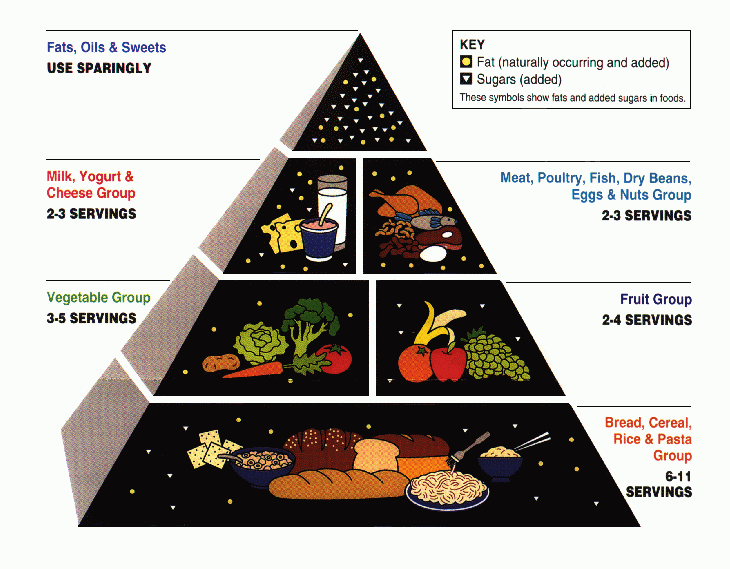
years, the back of the Cheerios box had the government-issued food
pyramid that clearly instructed us to eat six to eleven servings of
bread, cereal, rice, and pasta. Being very health conscious, my
mom filled our house with all the recommended foods, and also extolled
the dangers of any food high in fat or cholesterol. Well, I didn't
challenge her on this then, but, sorry mom, I'm here to be your
challenge child once again...
Who amongst us has never been under the assumption that eating fat makes us fat? In my 28-years of life, I haven't known a single person who didn't think this, or if they did, they never vocalized it near me. Sure some people ignore "fat is bad" and choose to "indulge," but I don't recall anyone telling me that fat is nutritious until the medical establishment came out with a tentative approval of "good fats" in the late 1990's. This fat demonization was something I never questioned. On the surface, it is a linear line of logic: you eat fat and then your body stores this same fat. The "good fat" approval in the 1990's was our first clue that there was something wrong with this conclusion. Today, let's look at a brief history of nutrition as it relates to medicine and politics. In future posts, I'll get into more detail on the science and evidence that underpins our current paradigm.
First, let's rewind to a time when our society didn't actually agree that fat was bad for us, which surprisingly wasn't a medical consensus until the early 1980's (and then backtracked with the omega-3 asterisk in the late 1990's).
1797: Scottish surgeon, John Rollo, detailed his success in treating diabetes in British Army officers stationed in the fruit-rich Caribbean with an "all meat" diet.
1863: An obese Brit, William Banting, published his "Letter on Corpulence Addressed to the Public," where he detailed a diet that helped him lose weight by giving up bread, milk, sugar, beer, and potatoes. His booklet was so popular in Britain that his name ("banting") became synonymous with dieting.
1889: Joseph von Mering and Oskar Minkowski observe that surgically removing the pancreas led to an increase in blood sugar, followed by a coma and eventual death.
1922: Two Canadian doctors, Frederick Banting and Charles Best, realize that homogenizing the pancreas and injecting the derived extract reversed diabetes mellitus. They win the 1923 Nobel Prize in Medicine for this discovery.
1925: French scholar, Jean Anthelme Brillat-Savarin, describes in "The Physiology of Taste" how fat prevents obesity by allowing for satiety. His book was so popular that it never went out of print and remains available today).
1952: President Eisenhower has a heart attack. The U.S. medical establishment is receiving many questions regarding the cause of heart disease and research on the topic becomes popular.
1953: Frederick Sanger sequences insulin. This is officially the "discovery" of insulin, since even though it had been isolated and used, we did not previously know it's chemical composition. Sanger receives a Nobel Prize in Chemistry for his work in 1958.
This brings us to the era where our modern nutritional guidelines were established. Two prominent doctors, John Yudkin and Ancel Keys, have a rather public, ongoing academic spar on the cause of cardiovascular disease. Yudkin strongly condemns sugar ("pure, white, and deadly") as the culprit, while Keys believes the cause is "artery clogging" saturated fat and cholesterol. Both sides have a lot of compelling data and this debate plays out in the scientific community until politics gets involved.
In 1967, Senators Bobby Kennedy and Joseph Clark toured the South to check on the progress of the Economic Opportunity Act of 1964, the landmark legislation of Kennedy's "War on Poverty." The senators saw thousands of American children who were going hungry to the point of starvation. CBS News covers the trip in a special program called "Hunger in America." The public attention to the issue causes increased political interest in the issue, particularly during the presidential election. The Senate debates the issue and forms the U.S. Senate Select Committee on Nutrition and Human Needs chaired by Senator George McGovern and, rather quick by Washington standards, becomes functional in 1968. (Historical context: Bobby Kennedy was assassinated on June 5, 1968 and Richard Nixon is elected president on November 5, 1968.)
In 1969, the committee works with the Nixon administration to organize the White House Conference on Food, Nutrition, and Health. The official recommendations from this bipartisan conference were to expand the food stamp program, improve child nutrition programs, improve other nutritional programs, and increase consumer protection information activities (e.g., nutrition labels). This is the impetus for the committee to create official nutrition recommendations.
For several years, the select committee held hearings in which it heard from academics, educators, nutritionists, doctors, and the public. What's most clear from the testimony, is that there is no consensus. The USDA even acknowledges on their official website that there was much controversy regarding the results. As I've alluded to before, the then-president of the National Academy of Sciences, Phil Handler, issued the following rebuke in his testimony: ''What right has the federal government to propose that the American people conduct a vast nutritional experiment, with themselves as subjects, on the strength of so very little evidence that it will do them any good?''
The motivations for the guidelines weren't malicious: they began with a society distressed at the societal failure of starving children in our own backyard. That being said, the guidelines were somewhat reckless. There was political pressure to produce something concrete from all these years of hearings, but all those hearings really produced was a lack of scientific consensus and no incontrovertible evidence for specific foods. Yet, the committee built a consensus for the guidelines by going with what seemed to have the most support.
The official U.S. nutritional guidelines were issued in 1977. Americans were instructed to increase their carbohydrate intake to 55 to 60 percent of calories and to limit dietary fat intake to no more than 30 percent of calories, particularly in regard to saturated fat. I'll get into further detail on the "evidence" behind this recommendation, but to summarize here, the reasoning for this looks similar to the "calorie is a calorie" logic.
"If a heart attack is caused by fat being trapped in arteries, we need to reduce the amount of fat we are ingesting so it doesn't build up in our arteries." Here again this reasoning disregards the fact that the human body metabolizes macronutrients in different ways for specific reasons. It's also a bit like blaming water for a clogged drain. "Pour less water down the drain and the pipe won't get clogged" doesn't sound logical to most people, yet this is exactly the same logic behind reducing fat intake. Is the plaque building up in our arteries a product of fat? Or is fat just getting stuck in something ELSE that is building up in our arteries?
There is other epidemiological evidence that has led to this consensus that fat causes heart disease; however, these studies conclusions are scientifically shaky. These same studies that are cited for why we should reduce fat intake, were strongly disagreed with when they were first published. I'll break a few of these key studies down in detail in a future post.
The point is, we didn't yet have the science to give nutritional recommendations based in hard facts. But a few powerful individuals decided IT SHOULD BE DONE ANYWAY. Since the late 1970s, the scientific community has developed a much better understanding of endocrinology (the study of hormones and the metabolism) and has much better evidence to establish revised nutritional recommendations. Unfortunately, these revised nutritional recommendations are contradictory to what is now conventional wisdom and it's difficult to reverse course 180 degrees. That's why this is something that may slowly build to become conventional wisdom, but for now will only reach the independent thinkers who seek it out.
I'll leave you with the following thought from Gary Taubes, keeping in mind the above timeline: "According to Katherine Flegal, an epidemiologist at the National Center for Health Statistics, the percentage of obese Americans stayed relatively constant through the 1960's and 1970's at 13 percent to 14 percent and then shot up by 8 percentage points in the 1980's. By the end of that decade, nearly one in four Americans was obese. That steep rise, which is consistent through all segments of American society and which continued unabated through the 1990's, is the singular feature of the epidemic. Any theory that tries to explain obesity in America has to account for that. Meanwhile, overweight children nearly tripled in number. And for the first time, physicians began diagnosing Type 2 diabetes in adolescents. Type 2 diabetes often accompanies obesity. It used to be called adult-onset diabetes and now, for the obvious reason, is not."
Who amongst us has never been under the assumption that eating fat makes us fat? In my 28-years of life, I haven't known a single person who didn't think this, or if they did, they never vocalized it near me. Sure some people ignore "fat is bad" and choose to "indulge," but I don't recall anyone telling me that fat is nutritious until the medical establishment came out with a tentative approval of "good fats" in the late 1990's. This fat demonization was something I never questioned. On the surface, it is a linear line of logic: you eat fat and then your body stores this same fat. The "good fat" approval in the 1990's was our first clue that there was something wrong with this conclusion. Today, let's look at a brief history of nutrition as it relates to medicine and politics. In future posts, I'll get into more detail on the science and evidence that underpins our current paradigm.
First, let's rewind to a time when our society didn't actually agree that fat was bad for us, which surprisingly wasn't a medical consensus until the early 1980's (and then backtracked with the omega-3 asterisk in the late 1990's).
1797: Scottish surgeon, John Rollo, detailed his success in treating diabetes in British Army officers stationed in the fruit-rich Caribbean with an "all meat" diet.
1863: An obese Brit, William Banting, published his "Letter on Corpulence Addressed to the Public," where he detailed a diet that helped him lose weight by giving up bread, milk, sugar, beer, and potatoes. His booklet was so popular in Britain that his name ("banting") became synonymous with dieting.
1889: Joseph von Mering and Oskar Minkowski observe that surgically removing the pancreas led to an increase in blood sugar, followed by a coma and eventual death.
1922: Two Canadian doctors, Frederick Banting and Charles Best, realize that homogenizing the pancreas and injecting the derived extract reversed diabetes mellitus. They win the 1923 Nobel Prize in Medicine for this discovery.
1925: French scholar, Jean Anthelme Brillat-Savarin, describes in "The Physiology of Taste" how fat prevents obesity by allowing for satiety. His book was so popular that it never went out of print and remains available today).
1952: President Eisenhower has a heart attack. The U.S. medical establishment is receiving many questions regarding the cause of heart disease and research on the topic becomes popular.
1953: Frederick Sanger sequences insulin. This is officially the "discovery" of insulin, since even though it had been isolated and used, we did not previously know it's chemical composition. Sanger receives a Nobel Prize in Chemistry for his work in 1958.
This brings us to the era where our modern nutritional guidelines were established. Two prominent doctors, John Yudkin and Ancel Keys, have a rather public, ongoing academic spar on the cause of cardiovascular disease. Yudkin strongly condemns sugar ("pure, white, and deadly") as the culprit, while Keys believes the cause is "artery clogging" saturated fat and cholesterol. Both sides have a lot of compelling data and this debate plays out in the scientific community until politics gets involved.
In 1967, Senators Bobby Kennedy and Joseph Clark toured the South to check on the progress of the Economic Opportunity Act of 1964, the landmark legislation of Kennedy's "War on Poverty." The senators saw thousands of American children who were going hungry to the point of starvation. CBS News covers the trip in a special program called "Hunger in America." The public attention to the issue causes increased political interest in the issue, particularly during the presidential election. The Senate debates the issue and forms the U.S. Senate Select Committee on Nutrition and Human Needs chaired by Senator George McGovern and, rather quick by Washington standards, becomes functional in 1968. (Historical context: Bobby Kennedy was assassinated on June 5, 1968 and Richard Nixon is elected president on November 5, 1968.)
In 1969, the committee works with the Nixon administration to organize the White House Conference on Food, Nutrition, and Health. The official recommendations from this bipartisan conference were to expand the food stamp program, improve child nutrition programs, improve other nutritional programs, and increase consumer protection information activities (e.g., nutrition labels). This is the impetus for the committee to create official nutrition recommendations.
For several years, the select committee held hearings in which it heard from academics, educators, nutritionists, doctors, and the public. What's most clear from the testimony, is that there is no consensus. The USDA even acknowledges on their official website that there was much controversy regarding the results. As I've alluded to before, the then-president of the National Academy of Sciences, Phil Handler, issued the following rebuke in his testimony: ''What right has the federal government to propose that the American people conduct a vast nutritional experiment, with themselves as subjects, on the strength of so very little evidence that it will do them any good?''
The motivations for the guidelines weren't malicious: they began with a society distressed at the societal failure of starving children in our own backyard. That being said, the guidelines were somewhat reckless. There was political pressure to produce something concrete from all these years of hearings, but all those hearings really produced was a lack of scientific consensus and no incontrovertible evidence for specific foods. Yet, the committee built a consensus for the guidelines by going with what seemed to have the most support.
The official U.S. nutritional guidelines were issued in 1977. Americans were instructed to increase their carbohydrate intake to 55 to 60 percent of calories and to limit dietary fat intake to no more than 30 percent of calories, particularly in regard to saturated fat. I'll get into further detail on the "evidence" behind this recommendation, but to summarize here, the reasoning for this looks similar to the "calorie is a calorie" logic.
"If a heart attack is caused by fat being trapped in arteries, we need to reduce the amount of fat we are ingesting so it doesn't build up in our arteries." Here again this reasoning disregards the fact that the human body metabolizes macronutrients in different ways for specific reasons. It's also a bit like blaming water for a clogged drain. "Pour less water down the drain and the pipe won't get clogged" doesn't sound logical to most people, yet this is exactly the same logic behind reducing fat intake. Is the plaque building up in our arteries a product of fat? Or is fat just getting stuck in something ELSE that is building up in our arteries?
There is other epidemiological evidence that has led to this consensus that fat causes heart disease; however, these studies conclusions are scientifically shaky. These same studies that are cited for why we should reduce fat intake, were strongly disagreed with when they were first published. I'll break a few of these key studies down in detail in a future post.
The point is, we didn't yet have the science to give nutritional recommendations based in hard facts. But a few powerful individuals decided IT SHOULD BE DONE ANYWAY. Since the late 1970s, the scientific community has developed a much better understanding of endocrinology (the study of hormones and the metabolism) and has much better evidence to establish revised nutritional recommendations. Unfortunately, these revised nutritional recommendations are contradictory to what is now conventional wisdom and it's difficult to reverse course 180 degrees. That's why this is something that may slowly build to become conventional wisdom, but for now will only reach the independent thinkers who seek it out.
I'll leave you with the following thought from Gary Taubes, keeping in mind the above timeline: "According to Katherine Flegal, an epidemiologist at the National Center for Health Statistics, the percentage of obese Americans stayed relatively constant through the 1960's and 1970's at 13 percent to 14 percent and then shot up by 8 percentage points in the 1980's. By the end of that decade, nearly one in four Americans was obese. That steep rise, which is consistent through all segments of American society and which continued unabated through the 1990's, is the singular feature of the epidemic. Any theory that tries to explain obesity in America has to account for that. Meanwhile, overweight children nearly tripled in number. And for the first time, physicians began diagnosing Type 2 diabetes in adolescents. Type 2 diabetes often accompanies obesity. It used to be called adult-onset diabetes and now, for the obvious reason, is not."
Labels:
challenge child,
health,
history lesson,
mom,
nutrition,
think about it
Subscribe to:
Posts (Atom)